
Will 2022 be a year of contrasting narratives -- one filled with caution and the other with continued optimism?

The rupee gains became pronounced just before mid-day in Europe as the euro rose against the dollar after German judges removed a major obstacle to the region's new bailout fund, European Stability Mechanism.

Siemens reported solid results in the July-September quarter (fourth quarter, or Q4) of 2022-23 (FY23), with the top line growing 25 per cent year-on-year (Y-o-Y) to Rs 5,808 crore. The operating profit margin stood at 12.1 per cent, led by lower employee costs and other operating expenses. The company follows the October-September financial year.

Benchmark BSE Sensex rallied nearly 630 points while Nifty closed above the 16,500 mark on Wednesday after sharp gains in IT and energy shares amid positive global market trends. Buying in index majors Reliance Industries, Infosys and Tata Consultancy Services and FII inflows bolstered the sentiment. Shares of firms related to oil exploration and refineries were in heavy demand, with Reliance Industries rallying 2.47 per cent and ONGC by 4 per cent, as the government slashed windfall tax on petrol, diesel, jet fuel and crude oil.

ITC, Sun Pharma, Maruti, M&M, Tata Motors, HCL Tech, Wipro, Infosys, HUL, Bharti Airtel and Reliance were among the major losers. Kotak Bank rose the most by 1.59 per cent, followed by IndusInd Bank, Bajaj Finance and Bajaj Finserv. L&T, SBI, TCS and HDFC Bank also closed higher.
The S&P BSE Midcap and S&P BSE Smallcap indices gained 0.4% and 1%, respectively

Benchmark equity indices Sensex and Nifty settled with marginal gains on Thursday in a highly volatile trade amid the scheduled monthly derivatives expiry and muted trend in the US markets. The 30-share BSE Sensex closed 86.53 points or 0.13 per cent higher at 66,988.44, registering its third day of gains. During the day, it hit a high of 67,069.89 and a low of 66,610.35.

Eighty per cent, or 60 of the 75 companies that made their debut on the mainboard this financial year, ended their listing day with gains.

Gold prices extended losses for the fourth straight day by losing Rs 325 to Rs 31,100 per ten grams on stockists selling.

Tata Electronics' Rs 91,000 crore semiconductor fab in Dholera, Gujarat, in partnership with PSMC, will generate over 20,000 direct and indirect skilled jobs in the region and construction of the mega unit is expected to begin this year, according to a statement on Thursday. The planned unit - India's first commercial fab, marks Tata Electronics' entry into the global semiconductor industry. Tata Electronics said it is "proud to lead India's entry into global semiconductor fabrication".

The combined market capitalisation of BSE-listed companies hit an all-time high of Rs 337.67 lakh crore ($4 trillion) on Friday amid a rally in equities, mainly on account of favourable macroeconomic data and continuous foreign fund inflows. Rising for the fourth straight day, the 30-share BSE Sensex jumped 492.75 points or 0.74 per cent to settle at 67,481.19 points. During the day, it rallied 575.89 points or 0.85 per cent to 67,564.33 points.

The global billionaires list witnessed as many as 94 new entrants from India, stated a report by Hurun India on Tuesday. Following a net addition of 84, the country's billionaire tally touched 271 with their combined wealth at $1 trillion, noted the report. Mukesh Ambani, chairman & managing director of Reliance Industries, is the only Indian to make it into the top 10 of the Hurun Global Rich List 2024, a ranking of billionaires in US dollar terms.

In a fragmented electric three-wheeler market where no company has more than a 10 per cent share, leave alone a dominant presence, can Bajaj Auto storm in and become king? The company is set to launch its range of electric auto rickshaws in June and hopes to replicate its success in ICE three-wheelers where it is the undisputed market leader with a 63 per cent market share. Can it be crowned king of the electric three-wheeler market too? Overall, electric sale volumes are growing at breakneck speed.
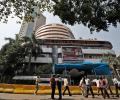
Of the 30-share Sensex pack, 15 today closed in the red

Investors have kept their eyes on US-China trade talks and are optimistic about a positive outcome.
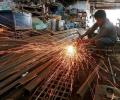
Manufacturing activities in India remained robust and price pressures were contained in October as new orders and production rose at a slower but stronger pace, according to a monthly survey released on Tuesday. The seasonally-adjusted S&P Global India Manufacturing Purchasing Managers' Index (PMI) was up from 55.1 in September to 55.3 in October. The October PMI data pointed to an improvement in overall operating conditions for the 16th straight month.

Benchmark indices Sensex and Nifty fell for the third day running on Thursday, dragged by continuous selling in HDFC Bank and profit-taking in consumer durables and utility shares. The 30-share BSE Sensex fell by 313.90 points or 0.44 per cent to settle at 71,186.86. During the day, it tanked 835.26 points or 1.16 per cent to 70,665.50.

Diversion of funds towards the surging equity weighed on the precious metal's price

Fundraising via the initial public offering (IPO) route by companies may touch Rs 1 trillion in financial year 2024-25 (FY25), according to a recent note by Pantomath Group - a mid-market investment bank. During the financial year 2023-24 (FY24), 76 companies tapped the markets through mainboard IPOs, Pantomath said, raising nearly Rs 62,862 crore. This is a 21 per cent rise compared to FY23, the note added.

India, the world's third-largest energy consumer and importer, on Wednesday warned of high oil prices hurting the nascent and fragile global economic recovery and floated an idea of long-term supply contracts that provide predictable and stable pricing. Speaking at the India Energy Forum by CERAWeek, Oil Minister Hardeep Singh Puri said there was a mismatch between demand for oil and the supplies producers such as OPEC+ were making and there was a case for raising the production. The world, he said, needs "predictable, stable and affordable" prices for it to recover back to pre-pandemic levels.

Manufacturing activities in India eased marginally in September but remained in good shape amid companies hiring more workers and cooling price pressures, according to a monthly survey released on Monday. The seasonally adjusted S&P Global India Manufacturing Purchasing Managers' Index (PMI) indicated a strong improvement in the health of the Indian manufacturing industry, as companies stepped up production in tandem with a sustained increase in new work intakes. The PMI at 55.1 in September continued to be in expansion mode for the 15th consecutive month but was slightly lower than 56.2 recorded in August.
Among the Sensex constituents, 20 stocks ended the session in green with HDFC Bank, Titan, Tech Mahindra, and Asian Paints being the major gainers. TCS, Maruti, Kotak Mahindra Bank and Bajaj Finserve were the other gainers. In contrast, SBI, Bharti Airtel, JSW Steel, PowerGrid, ITC and Reliance closed the trading with losses.

Increased demand for the dollar from importers affected the value of the rupee

'It's advisable not to go overboard on a banking sector fund or any other sector fund.'

Against the Reserve Bank of India's (RBI's) projection of 7.1 per cent, India's first quarter (Q1) 2024-25 (FY25) gross domestic product (GDP) growth came in at 6.7 per cent. This is in line with market expectations and significantly lower than the 7.8 per cent recorded in the fourth quarter (Q4) 2023-24 (FY24) and 8.2 per cent in Q1FY24. The quarter witnessed decreased government consumption and investment spending due to the parliamentary election.

The rupee depreciated further by 13 paise to hit a new life-time closing low of 82.30 against the US dollar on Friday as a firm American currency and risk-averse sentiment among investors weighed on the local unit. Moreover, a negative trend in domestic equities and elevated crude oil prices sapped investor appetite, forex traders said. At the interbank foreign exchange market, the local currency opened at 82.19, then fell further to 82.43. It finally settled at an all-time low of 82.30 against the American currency, registering a decline of 13 paise over its previous close.

Funds raised by India Inc. through offshore loan syndication hit a 15-year high in 2023 with companies and banks raising $21.4 billion, the highest since 2007. The momentum is expected to continue in 2024 as well with over $4 billion fund raising expected in the first three months of this year. Companies raise funds, both onshore and offshore, depending on interest rates and activities. Funds raised offshore can be deployed in overseas activities.
Among the Sensex firms, Bajaj Finance, Infosys, Tech Mahindra, ICICI Bank, Nestle, Tata Consultancy Services, HDFC Bank and Reliance Industries were the major laggards. Mahindra & Mahindra, JSW Steel, NTPC, Power Grid and IndusInd Bank were among the gainers.

Among Sensex shares, Tech Mahindra, Infosys, Asian Paints, ICICI Bank, Kotak Mahindra Bank, Titan, IndusInd Bank and Bajaj Finserv were the major laggards. Nestle, Tata Steel, Mahindra & Mahindra, Bajaj Finance, HDFC Bank and Tata Consultancy Services were among the gainers.

Very gradual fiscal consolidation glide path with looser-than-expected fiscal policy; good quality spending mix and reasonable assumption on fiscal math; and focus on privatisation, asset monetisation and long-term funding for infrastructure investments, according to Morgan Stanley, are the three key themes from the Budget 2021.

While Reliance put up a good show, NTPC nosedived on the BSE on Monday.

ICICI Bank was the top gainer in the Sensex pack, soaring over 6 per cent, followed by SBI, HDFC, PowerGrid, Sun Pharma, IndusInd Bank, Titan, Bajaj Auto and HDFC Bank. On the other hand, NTPC, Reliance Industries, Nestle India, HCL Tech and Infosys were among the laggards.

Bajaj Finserv was the top gainer in the Sensex pack, rising around 4 per cent, followed by Bajaj Finance, ICICI Bank, IndusInd Bank, Tata Steel, Axis Bank, HDFC and SBI. NSE Nifty rose 36.55 points or 0.31 per cent to 11,971.05.
M&M was the top gainer in the Sensex pack, rising around 5 per cent, followed by Kotak Bank, Bajaj Finance, Nestle India, SBI, ICICI Bank, HDFC Bank and ONGC. On the other hand, NTPC, IndusInd Bank, Bharti Airtel and Maruti were among the laggards.

The broader NSE Nifty sank 252.55 points, or 2.14 per cent, to 11,558.60.

The Softbank-backed company has set a price band of Rs 72 to Rs 76 per share for the maiden share sale and is expected to test the appetite for new-age loss-making companies.

Among the Sensex firms, ITC, Kotak Mahindra Bank, ICICI Bank, Nestle, Axis Bank, IndusInd Bank, UltraTech Cement, Bajaj Finance, Maruti and HDFC Bank were the major laggards.

The broadening of the market rally sends the signal that growth will be broad-based, observes Akash Prakash.

Equity benchmark Sensex ended marginally higher after a choppy session on Friday as concerns over the economic impact of the second wave of Covid-19 and pace of vaccination weighed on investor sentiment.
Indian growth in the rest of this fiscal year and next will be propelled by robust domestic consumption as consumer confidence improves, and by investment, including large increases in government capital expenditure, according to the Asian Development Outlook September 2023. "As slowing exports could foment headwinds for the economy, and erratic rainfall patterns are likely to undermine agricultural output, the growth forecast for FY2023 is revised down marginally to 6.3 per cent," ADB said.
